
Plain-language financial writing since 2012

Keep calm. Stay invested. Build lasting wealth.

Independent financial writing for high-earning professionals navigating RSUs, taxes, markets, and the noise in between. Written by Nirav Desai, founder of Qubera Wealth Management.

Book a Free Consultation →

2015 has been a roller coaster ride so far.

The stock market was down in January, up in February, and is now trending back down again in March.

Long term bond prices (US 20-year treasuries) were up 10% in January, and then drifted back down again.

And then there was today, Friday March 6th 2015, where the entire investment landscape was awash in a sea of red. It’s unusual to see all asset classes decline at the same time.

Usually, at least stocks and bonds move in opposite directions. But today everything was down – US and International stocks and bonds, real estate, energy, precious metals, you name it.

The only things up were the US Dollar, which is currently enjoying decade highs against other currencies.  And interest rates.

The yield on the 10-year treasury bond jumped from 2.1% to 2.25%, on the news of better-than-expected employment numbers.

This is likely what contributed to the major sell-off in the market today.

This may sound contradictory – better employment numbers means the economy is improving. And an improving economy should be better for the stock market, right? Unfortunately not. There’s no correlation between GDP growth and investment returns.

Investors are worried that an improving economy means the Federal Reserve will start increasing interest rates. Higher interest rates hurt businesses, and could kill the nascent recovery in the housing markets.

It’s also interesting that a lot of publicly-traded companies are issuing debt at historically low prices and using that money to buy back their stock. Companies like IBM and Apple are borrowing money at less than 3%, and instead of using that money to grow their business, they’re opting to reduce the number of shares. This acts to make each share more valuable. (Consider cutting a pizza into 4 slices instead of 8  – each slice is bigger, and thus more valuable). This phenomena has been driving a lot of the growth in the stock market, which is why large companies have outperformed smaller companies over the past few years. (Larger, more established companies can borrow money more easily and cheaply than smaller companies).

Higher interest rates could put the brakes on the bull market in stocks that has been going on for the past six years. And that’s what caused a lot of worry in the markets today.

So should we worry about rising interest rates?

I don’t think so. At least not yet.

Even if the US economy is improving, there is no inflation on the horizon. The Federal Reserve uses rate increases to help curb inflation. But seeing as there isn’t any, the Fed will be hesitant to raise rates too high or too fast.

Even if the Federal Reserve does increase the short-term rates they can’t impact long-term rates, which are set by market forces. And market forces are unlikely to let long-term rates rise any time soon.

While we’re seeing positive economic growth at home, globally, the picture looks a lot more glum.

Europe is in shambles with a recession, high unemployment, over-leveraged countries, and fears of deflation. Commodity-driven economies like Canada and Australia have been hurt by the sharp decline in oil and metal prices.  Even China, which used to be the growth engine of the world, is seeing a slowdown in its economy. And then there’s conflict in Ukraine and Russia.

To help counter this declining economic picture, 17 central banks have cut  interest rates this year.

Europe is trying so hard to stimulate economic growth, banks are paying people to borrow money! (Source: New York Times)

And already 16% of global government debt has negative yields. Yes, the yield on bonds of Germany, Switzerland, France, Belgium, Denmark, Finland, Sweden, Austria and the Netherlands is less than zero.

You give the government your hard-earned money and after a certain amount of time, you get less money back.

Not only governments, but even global food giant Nestle was able to issue short-term bonds last month with a negative yield.

If this wasn’t bad enough, the European Central Bank just initiated a trillion-Euro quantitative easing program. Injecting this kind of money in to the economy will further devalue the Euro and ensure that interest rates on European government bonds stay negative. 

There is an awful lot of money sloshing around, and it needs to find a home.

I’ll bet that a lot of it ends up in US treasuries. When US 10-year bond yields 2% more than German 10-year bond, that’s an easy bet to make. (Surprisingly,even countries like Portugal and Spain whose bonds are rating as “junk”, have lower interest rates than the US! Usually, when you lend money to subprime borrowers, you charge them a higher interest rate).

This demand for US treasuries will prop up bond prices and continue to keep the yield low. And until things turn around globally, I doubt we’re going to see an increase in the yield on long-term debt.

And wealthy foreigners, who are facing the prospect of negative yields in their devaluing home currency, may instead choose to park their cash US real estate instead.

So I’d say there is a chance the real estate boom might continue for a little bit longer.

And compared to the guaranteed loss of purchasing power with negative-yielding bonds, gold is starting to look like a high-yield investment! Maybe, 2015 will see a change in the sentiment towards gold as well.

Does this mean it’s smooth sailing for the stock market?

Not necessarily.

The current bull market in US stocks is getting long in the tooth. It’s been six years since we’ve seen a major correction. So it wouldn’t be unreasonable to see a 20% correction within the next year or year-and-a-half.

A correction isn’t something to be feared. It gives the market time to digest its gains, and for investors to buy in at a cheaper price.

Even if you’re fully invested, you shouldn’t panic and bail in anticipation of a bear market. More money has been lost in anticipation of a correction than in actual corrections.

Besides, foreign developed and emerging markets have been lagging the US stock market for the past few years and are between 20% and 30% cheaper from a valuation standpoint. It’s about time they played catch-up.

So, as I often like to point out, maintaining a globally-diversified portfolio will prove to best the best course of action.

However, I think the major beneficiary of this situation will be intermediate-term Municipal Bonds.

Most investors overlook Munies, which this is a mistake, especially for high earners.

If you’re in a high tax bracket you might be able to pick up bonds with an 7.5% tax-equivalent yield. That’s a great opportunity in this low-interest rate environment.



{ 0 comments }

There’s Always Something To Worry About

2014 is almost over.

And fear has dominated the news headlines for most of the year.

We had a war between Russia and the Ukraine, bombings in the Middle East, Ebola reaching the US, a military coup in Thailand, ISIS, fears of European recession, an actual recession in Japan, civil unrest in Ferguson, and Black Friday retail sales that were widely reported as being a bust (the implication being that the US consumer is broke).

We also dealt with the announcement that the Federal Reserve will end Quantitative Easing this year, which led to widespread fear that interest rates would soar, leading to a stock market and real estate collapse.

And we just witnessed a collapse in oil prices, which has renewed the fear of recession.

Meanwhile, the bull market in US stocks has kept chugging along. US stocks have continued to surprise both investors and market “experts” alike by returning 13% this year.

While stocks in Developed and Emerging countries have severely lagged US stocks, long-term US Government bonds are up an unbelievable 18%. (Bond prices and interest rates move in opposite directions. The reason why long-term bonds are up so much is because the corresponding interest rates have dropped quite a bit).

But the biggest winner this year has been US REITS (Real Estate Investment Trusts), returning a whopping 28% year to date. So much for rising interest rates hurting performance!
The biggest loser has been commodities, with a commonly used basket of commodities down 20% for the year.
This isn’t surprising since commodities usually have an inverse relationship with the US dollar – as the dollar strengthens against other currencies, commodity prices tend to fall.
And right now, the US dollar is at a seven-year high against major currencies. Not something anyone would have predicted back in 2008 when we thought we were on the verge of financial collapse.

The main lesson here is there’s no such thing as a sure bet in the stock market.

No one can predict which asset class will have the best performance, which is why maintaining a well-diversified portfolio is the best strategy.

This past week has been a rough one for the market.

We might even be on the verge of a correction (although I doubt it). It has been three years since we have experienced a 10% decline in US stocks – which is unusual, since this event usually occurs at least once year.
On the other hand, we are also entering the historically most-bullish time of the year for the stock market. And there is also research that indicates the high likelihood of strong market performance during this period in the presidential election cycle.
If your investment time horizon is longer than 25 years (including both the accumulation and distribution phases) then use any pullback or correction as a good buying opportunity. Remember that stocks, as a group, become less-risky after they fall in price. Use the recent weakness and bullish time of year to make your year-end IRA contributions.

Wish you all a very Merry Christmas, Hanukkah, Kwanza, or Festivus!

{ 0 comments }

Economic Review: What’s Next For The Stock Market?

Last week, the US stock market closed at an all-time high.

And I’ve received multiple queries asking if this is a true reflection of the economy and what is the best course of action to take right now.

Has there been a meaningful economic recovery at all?

Every time I turn on the radio or TV I hear polarizing views on this topic. Either the economy just hasn’t recovered and we’re in a stock-market (or real estate) bubble on the verge of collapse, or the economy is chugging along like everything is peaches and cream.

Of course, reality lies somewhere in the middle.

Unlike the typical post-recession recovery, this one features below-average job creation, stagnant wages, weak retail sales, and disappointing GDP growth.  But, these represent the average.

The recovery hasn’t been evenly distributed, with some sectors far outpacing others.

At the lower end, minimum wage jobs are plentiful, but it’s next to impossible to support a family on one.  If you’re a low or medium-skilled worker, plenty of jobs are available, although the wages are flat or even slightly lower than they were in 2007.

At the other end of the spectrum, people with graduate degrees face an unemployment rate of less than 3%. Especially those employed in sectors like technology, science, engineering or math, which pay 50% more than the median US wage.

Or, if you’re working in the booming Shale Oil regions of North Dakota, unemployment is virtually zero. Even Walmart, which is notorious for being a poor paymaster, is willing to start off its employees at $17.20 an hour.

Instead of creating jobs, the Federal Reserve’s quantitative easing and zero interest rate policies may have just helped boost stock prices and real estate values.

But if you don’t own any assets or have access to cheap financing, these policies aren’t really helping you.

Less than 65% of the US population owns real estate.  And only 50% of the people own any stocks.

If anything, it would appear that the Federal Reserve policies seem to be increasing the divide between the bottom half and the top half of society.

Over the long term, this increasing disparity is bad for the economy.  We want a virtuous cycle, where increased wages for everyone leads to higher consumer spending and thus a more robust economy.

And it might be even worse than it appears on the surface.

According to the Pew Research Center, the top 7% of households have gotten 28% richer while the bottom 93% saw their wealth decline 4%.

While there are certain caveats to their methodology (like using income vs. net worth, or mean vs. median numbers, as well as differing sources of data), it’s directionally accurate. The richer someone is, the more likely he is to own stocks and real estate, and it makes sense he or she would benefit disproportionally in the current environment.

But in general, the average person can’t be bothered with their investments.

According to a recent survey of 1,000 US investors by Gallup, 30% thought US stocks were flat, or had declined last year. This is in the face of a record performance in terms of stock market gains. And only 7% of investors were aware of this performance.  This means 93% of investors were unaware of the stock market’s record performance.

If I had to guess, it’s probably the same 93% who’ve seen their wealth decline in the past five years.

Looking back at every 5-year period since 1871, the last 5 year period has been the 4th best time to be an investor. In fact, over the past decade, the stock market returns have been pretty much in line with the long term average returns we’ve seen over the past several decades.

If you’ve struggled with your investment returns during the past five years, your future performance is unlikely to be any better.

This year the stock market has performed better than most people expected.

Nearly every single asset class is up for the year, including last year’s worst performer – Gold Mining Stocks which are up about 25%, followed by US Real Estate Stocks which are up 21%.

Overall, every single one of our diversified portfolios is up over 6% (individual account performance may differ based on when they were funded), with the exception of our Dividend Stock portfolio which was up over 10%, outpacing the return of the S&P500.

Meanwhile, it seems like there are a lot of “experts” on TV calling for a crash.

Mostly recently, founder of the Prudent Bear Fund (BEARX) – David Tice, called for a 60% crash in stocks.

He’s made similar calls in 2012 and 2010. And he’s been wrong every time. Meanwhile the BEARX fund has had a negative rate of return over every time period – it basically lost money over the past 1 year, 3 years, 5 years, 10 years, and 15 years.

Meanwhile, it charges 1.75% in fees and manages nearly half a billion dollars.

How do you manage so much money, charge such high fees, and yet provide such lousy performance?

By selling fear.

But, the real poster child for fear mongering is John Hussmann.

Author of a weekly newsletter, John Hussman has a PhD in economics and has been bearish on the US economy for the past several years. His fund, the Hussman Strategic Growth Fund (HSGFX), has also managed to provide negative returns over every time period.  Unlike BEARX, however, he even managed to lose money in 2008.

He’s figured out how to lose money in every possible situation. Quite an achievement!

But his fund manages over a billion dollars. With a 1.08% expense ratio, he manages to pull in over $10 million a year for the privilege of losing money.  What a great gig!

While bearish “experts” like Tice and Hussman frequently cite the poor economic recovery as a reason for expecting a major stock market crash, I’d like to point out that there is absolutely no correlation between GDP growth and stock market returns. The economist has an interesting article on this illusion of growth.

As an example, look at Greece – while it’s economy has been shrinking over the past few years, the Greece country fund (GREK) has been a top performer returning 29% and 24% in 2012 and 2013 respectively.

So what do you do?

My advice is to ignore all the news you hear on TV. These “experts” usually have some hidden agenda and have often paid a couple of thousand dollars to be on show.  Additionally their grandiose predictions and passionate sound bites help boosting TV ratings.

You’re better off turning off the financial news and reading some good books instead.

Don’t get me wrong. We will definitely see a decline in the stock market at some point.

In fact, a 20% decline typically occurs once every 4 years, and a 30% decline once a decade. But this is a normal and expected part of the investment process.

So far, our academically-proven process of investing in a diverse portfolio coupled with regular rebalancing has been working extremely well. And we expect this methodology to continue to provide great results into the far future.

So my advice is to continue investing according to your long-term strategy. If the market declines, you’ll be making future purchases at a discount.

And regardless of what happens in the near-term, your long-term performance is determined by your time in the market, and not by timing the market.

It’s the last day of the last weekend of summer.  Spend your time enjoying it and not worrying about the short-term fluctuations in the market.

If you’d like to sit down to discuss your financial situation, or need a second opinion on your portfolio, I’m always happy to do so.

Wish you a happy Labor Day!


{ 0 comments }

Is It A Good Time To Buy Real Estate?

As I write it this, the national housing market seems to be recovering slowly, although it is showing signs of slowing down again.

But certain markets seem to be going crazy.

Southern California, where I live, is one of them and the real estate market is on fire right now.

I’m currently in the market for a house myself, and I’ve also received several queries from clients asking if it’s a good time to buy real estate.

My misgivings about the real estate market in Southern California have been building over the past year, during which time home prices (and rents) have jumped about 20-25%. Despite the rental price increase, it is cheaper to rent than it is to buy.

My major concern was that Private Equity firms bought more than 20,000 homes last year as investments.  While this forces prices upward in the short-term, I worry about what will happen if they decide to sell them all at once.

Private Equity firms are not long-term investors. Highly opportunistic, they’ll bail as soon as something else looks better. Even if nothing does, they probably will start looking to liquidate in about three to five years.

On the negative side, the median wage has been roughly flat for the past five years – and 11% of LA County residents are on food stamps.

Mortgage applications have also been declining every month for a year, as fewer people now qualify for mortgages.  However, this has been offset by an increase in the number of all-cash home purchases.

Currently, 30% of all home sales are to all-cash buyers. Based on anecdotes from real estate agents, investors and lawyers, it seems like there are a large number of rich business owners from South East Asia are looking to park money in the SoCal real estate market.

If history is our guide, then foreigners are more likely to invest in real estate at market peaks rather than market bottoms.

The last time we saw a large influx of foreign buyers was during “Baburu Keizai”, or Japan’s bubble economy in 1990. It was said that a square inch in Tokyo’s Ginza district was more expensive than a square mile of land in the US.

And it ended badly for Japanese investors.

With home prices reaching astronomical levels all over Asia, could it be we’re going to see history repeat itself?

Given this economic backdrop, why would I be willing to buy a home in this market?

Why would I be willing to tie up a major portion of my networth in an illiquid asset with uncertain prospects?

Why would I be willing to join the 39,000 foreigners who moved to Los Angeles County in the past year and maybe buy at the top of the market?

Why would I be willing to pay 20% more to own a home vs. renting it (even after factoring in the tax break)?

Why would I promote the current home-buying frenzy that has resulted in 87.8% of homes having multiple offers, and 53% of them selling for over the asking price?

Is it because I think home ownership is a good investment?

Do I think that paying 4.7% over list price and besting four other offers is the hallmark of a smart investor?

No, not at all.

The best reason to buy your own home is for your own personal reasons, not economic ones.

Despite what the media tells you, your home is not your largest investment. If it is, it just means you’ve done a lousy job of saving and investing for your future. Catherine Rampell over at the Washington Post has an excellent article on the “fetishization” of home ownership.

Over the past century, homes appreciated at 0.3% over inflation, and far, far less than the 10.11% of stock market returns.

Your home is not an investment. It’s a money pit.

You buy it because it provides shelter, warmth and a safe, stable place to raise a family. And especially for men (who become more grouchy as they get older), it provides a place to barricade themselves from their neighbors!

Your home is your largest liability, and should be treated as such.

As a liability, you need to make sure you don’t become house-horny and bite off more house than you can afford. (House-horniness is an emotional condition that stems from lusting over champagne homes on a beer budget, and often results in misery: source Dr Housing Bubble)

Keeping your loan balance under 3.5 or 4 times your annual household income will help prevent becoming house-poor. (Ideally, you want it around 3 times household income).

When considering your purchase, don’t forget to include property taxes, insurance costs (which should also include an umbrella policy), HOA fees or maintenance, and larger utilities & water bills.

Since you can no longer complain to your landlord or building supervisor if something breaks, it’s now your responsibility to fix everything. So count on additional headaches too.

As embarrassing as it is to admit that we got in to a small bidding war during what’s possibly a market peak, at least we are in a position to afford it and not be house poor.

And unlike the previous bubble, I can take solace in the fact that I’m competing with all-cash buyers and not minimum wage workers with NINJA loans (No Income, No Jobs or Assets).

But that still doesn’t make it a good investment!

The point is not to confuse a home purchase with an investment.  Unless you’re planning to rent out all the spare bedrooms and cover all your costs. (Something I would have considered if I was 20 and single).

With an investment, you expect to make money, either through regular dividends or interest payments, or when you sell.

With your own home, the best you should expect is to break even when you sell (after considering inflation and opportunity costs).

I don’t expect to sell this home for decades, but when I do I know inflation will have boosted its value. It’ll probably sell for five times it’s currently worth – but that will be because everything will cost five times more, not because it’s a great investment.

So if you’re in the market for house as well, make sure you buy something that won’t make you house poor and because it’s the right time in your life to make that sort of long-term commitment.

Also be cognizant of the fact that you could be living in your house for a lot longer than you realize.

If property prices drop you could find yourself underwater with no down payment for a larger home. Alternatively, if the economy recovers causing a spike in interest rates, you might not be able to afford a bigger house with the larger mortgage payment.

Owning a home also limits your mobility in terms of future employment opportunities.

But so long as you have a stable job, can afford the payments and are okay with the possibility of having to stay put for longer than expected, you should be fine.


{ 0 comments }

The Truth Behind Hidden 401(k) Plan Fees

Five years, Bloomberg ran a special about the hidden fees in nearly all 401(k) plans.

Most participants thinks that there no fees in these plans. Over half of HR managers also think the same thing.

[embedplusvideo height=”315″ width=”420″ editlink=”http://bit.ly/1bGatKb” standard=”http://www.youtube.com/v/08UPQ3JaRek?fs=1&vq=hd720″ vars=”ytid=08UPQ3JaRek&width=420&height=315&start=&stop=&rs=w&hd=1&autoplay=0&react=1&chapters=&notes=” id=”ep4323″ /]

[embedplusvideo height=”315″ width=”420″ editlink=”http://bit.ly/1bGaL3D” standard=”http://www.youtube.com/v/94eDjL4ciVE?fs=1&vq=hd720″ vars=”ytid=94eDjL4ciVE&width=420&height=315&start=&stop=&rs=w&hd=1&autoplay=0&react=1&chapters=&notes=” id=”ep5870″ /]

[embedplusvideo height=”315″ width=”420″ editlink=”http://bit.ly/1bGaPk9″ standard=”http://www.youtube.com/v/x1NPUf2Q-sw?fs=1&vq=hd720″ vars=”ytid=x1NPUf2Q-sw&width=420&height=315&start=&stop=&rs=w&hd=1&autoplay=0&react=1&chapters=&notes=” id=”ep9283″ /]


Since then, things have gotten slightly better, but not by much.

Congress has since mandated that all plans disclose the fees charged to the participants in 401(k) plans, it’s still notoriously hard to figure out.

One way the average user can figure out their fees is using Brightscope.com. While it may not be 100% accurate, it’s still a step in the right direction.


{ 0 comments }

Hedge Funds Underperform for 5th Year In A Row

According to Bloomberg, Hedge Funds underperformed the S&P 500 for the fifth year in a row. On average, they delivered 7.4% vs. nearly 30% for the S&P.

This isn’t surprising.

Several years ago, legendary investor Warren Buffet bet $1 million that the S&P 500 index would bet Hedge Funds over a ten year period. At that time, the index was deep in the hole, having been down about 38% in 2008. Hedge Funds were slightly ahead, being only 24% down that year. (To see the arguments on both sides of the actual bet , click here).

But since then, the index has pulled ahead.

And that’s not surprising either.

Hedge funds are designed to make their managers and employees rich – not the investors.

Even if it were possible to accurately predict the future, repeatedly and consistently over a long period, the exorbitant fees charged by Hedge Funds make it unlikely the investors would actually prosper.

Hedge Funds usually charge a flat 2% per year of assets under management. Additionally, they levy a 20% performance fee on top of that.

Even if you were naïve enough to believe that a superior manager could outperform the market by 2-3% a year, paying 2-and-20 in fees would put you behind.

No wonder Buffett made a $1 MM bet.

In case you’re still debating whether to put your hard-earned money in a Hedge Fund, I strongly recommend this book: The Big Investment Lie: What Your Financial Advisor Doesn’t Want You to Know by Michael Edesess.


{ 0 comments }

World Stocks Are Oversold

The US stock markets have been on a tear this year, with the S&P 500 up about 30%.

However, world stocks have lagged in performance, and are currently over-sold. Over-sold is a somewhat ill-defined term, and in this context means the price of a stock is selling at less than 1 standard deviation below it’s 50 day moving average. Stocks that are oversold are more likely to undergo mean reversion, and the prices will increase.

Here’s an interesting chart from Bespoke Investments.

Country ETFs Oversold

{ 0 comments }

Where Are The Values Today?

As I mentioned in my last post, interest rates are likely to stay low for quite a while.

Investors are starved for yield, and have been bidding up the prices of dividend-paying stocks.

Boring stocks of electric companies and consumer staples (companies that make toothpaste, soap and cereals) usually have limited growth opportunities. Instead of reinvesting their earnings, they tend to pay it out to investors in the form of dividends. As a result, these stocks have slightly higher dividends, and trade at a slight discount to the market (based on their Price/Earnings ratios).

Investors in these sectors are exchanging growth for income.

However, in today’s environment, these stocks are trading at a premium to the average market. Overpaying for income is not how investors make money in the long run.

On the contrary, mature technology companies with massive profit-margins, steady growth prospects, but low dividends, are trading at a discount to the market.

So there is definitely some dislocation in the US markets. But based on continuance of quantitative-easing and the super low interest rates, this trend is likely to continue.

Looking at the foreign markets, we see better valuations in general.

At 14 times forward earnings, European stocks are currently 12% cheaper than their US counterparts, and have 50% higher yields too. However, they’re cheaper than they look on the surface.

Profits at US companies are hitting record highs, whereas in Europe they are at market cycle lows, and are on the upswing. As profits expand, so will the stock price and the yield.

The emerging markets are even cheaper. At less than 12 times forward earnings, they’re more than 25% cheaper than US stocks.

While emerging markets have been the sore spot in investor portfolios, significantly underperforming US stocks for the past three years, they are currently so cheap they warrant inclusion. Here’s an excellent paper by Vanguard on this topic.

But investors can do better than just buying cheaply here.

According to research by Jim O’ Shaughnessy, author of What Works On Wall Street, tilting towards undervalued, dividend-paying stocks in emerging markets beats the category by 10.6% per year over the long term.

As I’ve said before, maintaining a globally diversified portfolio is the key to long term wealth.

And global stocks definitely looks primed to perform well in the coming year.

But be sure to see our disclaimer.

{ 0 comments }

If You’re A Saver, You’re Selfish

The US stock market returns has certainly had a banner year, so far.

We’ve certainly had a lot to worry about such as the fiscal-cliff tug-of war, various European government and political scares, capital flight from emerging markets, tapering of the Federal Reserve bond-buying program, and the US Government shutdown.

And yet the market has maintained its solid march upwards, hitting new highs last week.

But while the stock market has been climbing higher, people looking for income to live on are stuck.

Right now, it’s the toughest environment for generating income in over 100 years.

According to data from Global Financial Data, a portfolio consisting of 60% stocks and 40% bonds has historically generated an average 4.4% yield. Right now you’re looking at an all-time low of less than 2.0%.

Janet Yellen, the new Federal Reserve Chairman, said she’s going to maintain this low interest rate environment.

An astute observer might think that low interest rates seem like a punishment for savers and especially for retirees. And they’d be right.

When faced with a similar question, Yellen said “we have to consider the role of people who have significant savings and their responsibility in society, that it really is selfish to be hoarding it and that we need to create incentives through government for people to spend their savings,  because that’s exactly what we need in order to rejuvenate the economy.”

Yes, the new Federal Reserve Chairman thinks people who save their money are selfish. And they need to spend their savings to help boost the economy.

Not only that, at a recent Senate Banking Committee hearing, she said if she could figure out how, she’d even introduce negative interest rates. This means you’d have to pay the bank to keep your money in a savings account, while those taking out a loan would be paid interest by the bank.

 You might think this is an incredibly stupid idea. I do.

Regardless of whether she’s right or wrong, the truth is that interest rates are going to stay close to zero for a very long time.

The Federal Reserve is going to maintain its loose monetary policy, which means the bond buying program is going to stay strong.  This bond buying injects money in to the economy, and it’s going to end up in stocks and real estate, and continue to push the prices higher.

Meanwhile, the US stock market has gone more than 18 months without a 10% correction. While we are not in bubble territory, as a whole, they are fairly valued.

But that doesn’t mean that prices are going to stop rising here.

Most likely, they’re going to continue their rise for quite a while. As previously explained, rising interest rates won’t stop this increase either.

As always, the best course is to keep calm and stay invested!

{ 0 comments }

Real Estate Update: Bargains Harder to Find

Based on my prior experience buying nearly two dozen homes across the country, I’m frequently asked for advice on buying real estate.

The attraction to real estate investing is easy to understand. Although real estate can’t be expected appreciate more than the rate of inflation (unless you have the vision to buy in to an area where demand is about to take off, such as Southern California circa 1960), the leverage and tax breaks make it look promising.

And the recent downturn, coupled with the ultra-low mortgage rates, have made real estate a hot investment in the past 12 months.

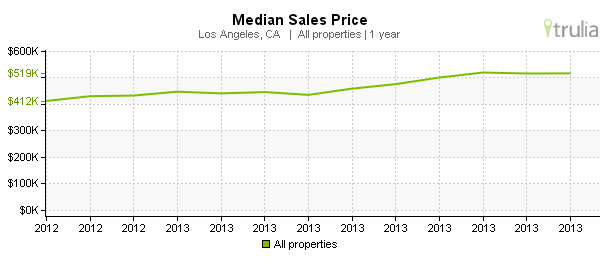
In Los Angeles, the median home price has jumped an eye-popping 23% in the past year, from $422,000 to $520,000.

Los Angeles Median Home Price 2013


So what does the future hold?

While it’s always hard to predict anything, it definitely looks like housing is getting overvalued in some areas.

Looking at the ratio of Median Home Prices/Median Household Incomes, we can see that California is getting expensive on a historical basis.

According to John Burns Real Estate Consulting, it’s 50% higher than the historical average in Los Angles, Orange County, San Diego and San Francisco.


Where to find real estate bargins

[Click to enlarge]

That’s not to say you can’t find a good bargain in this market. But they’re becoming a lot harder to find.

Unless you’re buying a house to live in yourself, it might be better to look in Florida, Arizona or  Nevada to get a better deal.


{ 0 comments }